Tuesday, February 25, 2014

Gold and Agriculture: California's Economic Engines

From the Bay Area to the foothills of the Sierra Nevada, it's a short drive across the Central valley, and the economic history of Northern California is laid bare. Leaving San Francisco via I-80, you emerge past the Oakland Hills and into the Central Valley, a mixture of agricultural fields and suburban office parks, where land is cheap, buildings sparser and car miles driven accumulate.


The Central Valley has pleasant weather year round - great weather, really. It provides this farmland to the world with 2-3 growing cycles per year. Times have been rough lately, with the current three-year worst-in-a-century drought, labor shortages due to the immigration clampdown, and tough environmental laws. Any romantic connection you may be inclined to have, from reading too much Hemingway or Kerouac, should be suppressed immediately.

In the lowland of the Sacramento Delta, Tahoe traffic fills the roads between Thursday night and Monday morning. You can stop off in Davis, home of the UC Davis Aggies. Davis is a pleasant little town with shady retail offerings, gracious sidewalks, a slow pace, lots of bikers and a lovely central green with a small corner building housing the U.S. Bicycling Hall of Fame.


Beyond Davis, The highway leads northeast around Sacramento and into the foothills of the Sierra Nevada, where the discovery of gold in the late 1840's shaped nearly a century of California history, building towns, driving immigration and making San Francisco the financial and cultural capital of western America, with iron high rise buildings and banks backed by every country along the Pacific rim.

A small group of gold rush era towns are known as the “gold chain”. Nevada City sits in this area, by Deer Creek. The City of Nevada City is a very small town with about 3,100 residents, down from 10,000 in 1870. The small downtown area, 2 blocks wide and 4 blocks long, slopes down hill, southeast, to Deer Creek. The buildings tend to be wood Victorians, some quite expressive, with some brick commercial buildings mixed in. The front porches of the houses transition to colonnades at the shops and century-old hotels. Vestiges of Nevada City's former prominence as a County Seat can easily be found - there's a Masonic Lodge, an Odd Fellows Hall, a couple of theaters, and more saloons than Dublin. Even an historic small Chinese quarter. Believe it or not, this town has 4 bookstores! Which is more than downtown San Francisco…  


Today, the town is a center for the local food / slow food movements, and a weekend getaway town for people from the Bay Area, Sacramento region, Reno, and other Central Valley locales. The real relic of the town’s legacy if the closed Empire Mine, just out of town, which is now reopened as a California State Historic Park.

To round out a weekend road trip we stopped in Chico, not really on the way but not too far either. Home of CSU Chico, it’s very similar to Davis and other small California towns with pleasant weather, a decent historic downtown centered on a plaza, and most importantly a college and all that comes with it. Not too many scholars were about town this holiday weekend, so it still had a mid-winter vibe, with a low sun, long shadows, youngish guys in shorts and a group of veterans congregating in the plaza.


Sunday, January 5, 2014

David Hockney - How Much Art Can One Man Make?

David Hockney is one of the best known artists in the world. An artist for 5 decades, the English painter is absurdly prolific. Born in 1937, he has shown no signs of slowing down. Over the last few years, he's composed an extended series of works depicting the English landscape, a personal yet expansive view that has probably not been equaled since the heydays of the mid-19th century Royal Academy and Ecole des Beaux-Artes.   

 
These last few years of work are chronicled in a show ending soon at the deYoung Memorial Museum in San Francisco, called "A Bigger Exhibition". The show primarily features Hockney's genre artwork. He works in the historic, well-established genres of landscape and portraiture. Other key genres are still life, history and "Bible", though these are rare territory for Hockney.

This exhibition included digital films, drawings in pencil and charcoal, and paintings in watercolor, acrylic and oil. Hockney is prolific in all of these -  he calls the films cubist, and the portraits are impressive too - but it is the multi-year dedication to depicting the English landscape that leaves the viewer absolutely engrossed, engaged and completely immersed. An over-arching theme for the painter is depicting the passage of time. On several groups of pieces, he draws or paints the same landscape scene over 4 different seasons - winter, spring, summer, fall - or he'll show the emergence of a season, as spring bursts from February to May. The works range from intimate 18" x 24" sheets, often done in series, to monumental pieces of 32 canvases arranged edge-to-edge, four up by eight across.


The draughtsmanship is that of a seasoned master, confident across any medium, oil to iPad. Through the work, we are always reminded that we are looking at an interpretation, at a translation. These images are representations of nature as filtered through the artist's mind and skilled, guided hand. The colors are stunning, playful, almost obscene at times. Trees are purple and green and yellow and tangerine. Leaves are blue and black and white. These landscapes are electric with their neon colors and their vibration and their whimsy and their depth. 

A glass vitrine full of his sketchbooks also showed that he draws all the time. On the plane, at the dinner table, at the cafĂ©, on the porch. He uses pencils, pens, markers, crayons, charcoal, watercolors, acrylic paint, oil paint. And most recently, since 2010, he's taken to drawing on his phone and iPad. He does great work with these digital tools, too. 

It would of been great to see some of this work in day-lit galleries, but the deYoung's new building, completed in 2005, did not include the natural lighting of artwork as a design feature - most museums don't, and that's a loss for us all. Hopefully the next generation of museums will do better.

At the exhibition, there were 2 rooms full of work that he had executed since the summer, after the work that was supposed to be the subject of the exhibition was already done. He draws more in a week than most people draw in a lifetime. My wife insists that he is so prolific because that is what he does. He is an artist. That is his occupation, his job. He does it all day, every day. And I agree.

For Christmas, my mom gave me a little book call Daily Rituals, which looks at the daily routines of artists and other creative people. The book begins with this table from Ben Franklin, of his ideal day - note that there's still 8 hours of proper "work" and 7 hours of sleep.  Happily he seemed to have no commute time!


For Hockney, he's cleary and artist with no other day job. He draws and paints all day. It's the same for some writers, who are known to methodically write, say, 5,000 words per day. It is their routine, which they follow methodically, whether they are feeling particularly creative – in the mood - or not.

But some of us paint after hours, after our daytime work. We're not dilettantes, it's simply that we have many passions, an some help pay the mortgage, while others are payless passions, that we pursue after hours, for little or no compensation. We act, write, create, paint, draw for the pleasure and the challenge and the pursuit offered by the creative process itself. We write plays, draw maps, make jewelry, teach, design furniture. You may find us on Esty.com, or at holiday craft fairs, or autumn open studios events. Here you will find our second selves, the other sides of us that battle with the day-job side. But we are not two-faced, we are Janus faced, two (or more) sides of complex people.

I am thankful that David Hockney pays his mortgage by painting!

Friday, January 3, 2014

Collages for Los Angeles

Two collages made following a weekend in Los Angeles, with visits to the James Turrell exhibition at the LACMA and the Huntington Art Gallery and Library.


Friday, September 13, 2013

Newport at Full Scale


Newport , RI, is one in the oldest cities in the country, and no doubt one of its most beautiful. Founded in 1639, it has the country's oldest synagogue and its first free black church. For almost 300 years it has been a summertime destination for east coast families. Boating, turn of the century mansions, recreation and partying - this is what Newport is known for.

It's original colonial era street pattern, public buildings and private dwellings have lasting appeal. Fine classical works include the Touro Synagogue, the Redwood Library (one if the oldest lending libraries in America) and the Brick Market.  

Besides its collection of narrow streets, downtown Newport has two important public spaces, Washington Square and Queen Anne Square. Civic buildings surround Washington Square, the city’s original public space – including the brick market (now a Newport History Museum), the Colony House, and the Courthouse, as well as a group of banks, hotels and a theatre. Queen Anne Square emerged more recently, in the 1970’s at the behest of Doris Duke. The square is anchored by Trinity Church, whose current building dates from 1726. Built in a classical design, it closely models in wood the masonry designs that Englishman Christopher Wren built around London in the late 17th century. Queen Anne Square has recently been refurbished and reopened this year also had some modest garden wall elements designed by Maya Lin, who famously designed the Vietnam Veterans Memorial as a college student.


Bellevue Avenue extends west and south from Newport's historic downtown, and it is along this street that wealthy old families built their summer cottages, mansions designed by top New York architects, displaying all they had learned at the Ecole des Beaux-Artes in Paris. 

As the 20th century dawned, Newport was well into its decision to forego industry and commerce and embrace pleasure and recreation as its raison d'ĂŞtre. The city is preserved like few others, not a relic but a living, breathing place - casual but not exactly thriving - where the form, shape, and character of America’s earliest settlements is preserved, at full scale. It is a fascinating place to experience, again and again. I grew up near Newport, but didn't fully appreciate it until moving away, to upstate New York for college. Since then, since studying Newport for a class on American Town Planning taught by Professor Anne Munly at Syracuse University, I've been fascinated with the design of Newport for almost two decades - a lasting affection.

Sunday, August 11, 2013

Form, Light and Forms Assembled in Light

Inspiration is everywhere.

One of my favorite aspects of living in New York City was that inspiration was everywhere. It was not on demand, but was easy to find. You could consistently replenish you creative juices with visits to the Met, the MOMA, the Cloisters, PS1, Shakespeare in the Park, or Shakespeare in the Parking Lot. Inspiration was omnipresent and usually affordable. That was a decade ago. Last weekend I learned that nothing has changed. In one weekend we saw a group of blockbuster museum and gallery shows of depth and the highest quality.
 
FORM
At the Gagosian Gallery in Chelsea, we saw an amazing installation, "Fragments", on the work of Italian architect Renzo Piano. Twenty-four projects were presented on a grid of square tables, with  drawings, mock-ups, animations, and wood models so exquisite they were like the works of skilled master craftsmen. Then we walked the High Line and got hot and iced coffees, respectively, and reflected on Piano's work, career, and broad geographical coverage.  We've been lucky enough to see many of the works showcased in "Fragments". Ultimately Piano's work consists of a legion of one-off creations, careful tectonic expressions, balancing engineered determinism with an intrinsic Italianate humanism that a century of modernism can't fully suppress.


LIGHT
The next day we saw the work of James Turrell at the Guggenheim Museum, a series of prints and magisterial installations. The rotunda installation is, and will be regarded as, a cultural event. The installation, called "Aten Reign" completely envelopes the rotunda with an inner scaffold of translucent oval scrims, receding as they rise to the oculus. Color-changing LEDs provide an dynamic aura of color tinting, wonderful blues, purples, reds, oranges. Custom-built inclined benches at the ground level allow for prolonged gazing up into the light. On upper floors, there were 4 more installations, each carefully composed with cerebral precision.
 
 
FORMS ASSEMBLED IN LIGHT
Le Corbusier said that "architecture is the skillful, correct and magnificent play of forms assembled in light" (this is one of many translations of this saying). To complete a trinity of modern masters, we went to "Le Corbusier: An Atlas of Modern Landscapes" at the Museum of Modern Art.  Make no mistake: this is an epic retrospective on the work of Le Corbusier (Charles-Édouard Jeanneret, 1887–1965), a classic modern fox (per Isaiah Berlin). Le Corbusier was prolifically productive and industrious over a very long career. His career traversed many great disciplines, those pursued by Palladio and Michelangelo and Leonardo - all together. Architecture, painting, sculpture, writing, publishing, teaching, lecturing, urbanism, photography, film-making, furniture, installation, visual evangelism. He was also a word traveler, avid sportsman and swimmer, man about town and smart dresser. He did not waste a day. The exhibition, across half of the MoMA's sixth floor special exhibitions rooms, was vast, with rooms full of original models, oil paintings, architectural plans, sketches, watercolors. He was a global architect a half century before it was feasible. His oeuvre was vast but not as vast as it could have been. His career was truly a patient search, a personal search, through the urban, pastoral, and mountainous landscapes that his life traversed.  
 
Taken as a group, these three exhibitions are worth the cost of a flight to New York City, from anywhere in the world.
 

Wednesday, July 24, 2013

Hey Utah!


Last month I visited Utah for the first time while attending a conference in the capital, Salt Lake City. I imagine Salt Lake City as being in middle America, but in fact the flight was only 75 minutes, closer to San Francisco than Seattle.  A light rail line connects you from the airport directly to downtown destinations, for only $2.50, leaving every 10 minutes.

The City is set at the southeast corner of Great Salt Lake, very much like San Jose is set at the southeast end of San Francisco Bay. Neither city is quite on the waterfront, but you're aware of the proximity. The city is sited at the northern, uphill side of a long, low, flat plane - Salt Lake Valley - which sits at the base of the steep Wasatch and Oquirrh mountain ranges on the eastern and western sides, respectively. Salt Lake City is a place that gets very hot and very cold - it's not for the timid.

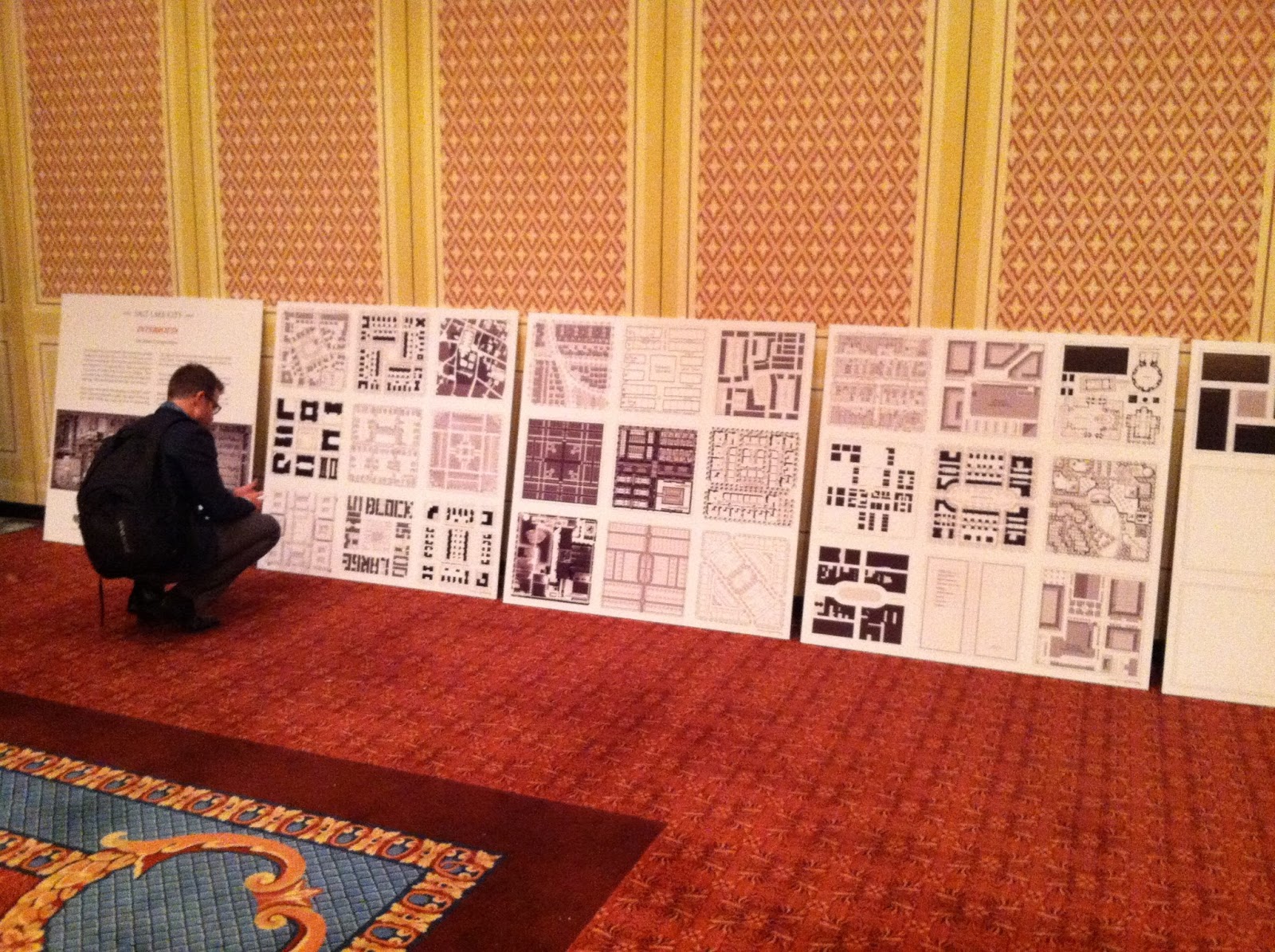
The city is laid out according to the "Plat of Zion," a peculiar planning pattern that includes 660' x 660' blocks - that's 10 acres each - and very wide streets with 132' rights-of-way. Over 500 settlements were established according to this pattern. There is a modestly sized downtown area, something of the CBD (central business district) found in so many cities west of the Appalachian mountains. This area has the tall buildings, the sporting venues, the 10-story parking garages, the Mormon facilities, the pubs (now open to all), and a few residents. Once you leave the downtown area, the city gets very un-dense very quickly. The surrounding neighborhoods are mostly made with one and two story single family houses.  A coffee shop, restaurant, and flower shop surrounding an intersection forms a local neighborhood center.

Pictures from my weekend in Salt Lake City are here:
http://share.shutterfly.com/action/welcome?sid=2AZsW7hs4ctWL9

The Culture of the City

Salt Lake City is like the Vatican of the Church of Jesus Christ of Latter Day Saints, referred to locally as the LDS, known internationally as the Mormons. The Mormon sites feature a distinctive kind or architecture - a bit depression-modern, a bit colonial-fascist, a bit corporate-communist. All in all, difficult to categorize, but you know it when you see it. Founded in 1847 by a group led by Brigham Young, today the city has almost 200,000 residents, about half Mormons. Touring around the city - by foot, by bike, by street car - you immediately notice that most adults are white, but most children are brown. Even the city of Joseph Smith cannot buck national trends towards diversification.


My conference was held at the Grand America Hotel, a luxurious 2002 Olympics era hotel, built in a bombastic classical style, evoking a Mitt Romney embrace of wholesome Americana. The conference, the 22nd annual held for the Congress of New Urbanism, was a lively event where I reconnected with old friends, made new ones, and wistfully thought of those skipping the event this year. The topics, like the participants, spanned practice and policy, local and global, humanists and technocrats. There were numerous and lengthy sessions on urban farming, China urbanization, digital technologies for public feedback, safe streets, great American grids, playing, and not-so-big-ness.


After the conference, we rode public bikes from the downtown Mormon Sites into the surrounding neighborhoods. We met lots of friendly residents, out on a warm late spring weekend afternoon. They were curious about our green bikes, which had been all over the papers in the lead up to their launch. Despite the active role played by the Mormon church in helping to enact California's Prop 8 prohibiting gay marriage, Salt lake City seemed to be a very gay-friendly place. The weekend I was there, a huge Pride parade was held downtown. It felt like home!